
BY EKATERINA SHIPYATSKY (Research Assistant - National Heritage and Traumatic Memory Cluster)
November 11, 2026
In July, participants in Thinking Through the Museum’s 2026 Annual Gathering visited museums and public memory initiatives throughout the city of Cape Town. Our itinerary spanned contemporary art museums, history museums, grassroots mural activist groups, and research labs at the University of Western Cape (UWC). Though the institutions and initiatives we visited each work with vastly different collections, operate on different scales, and use different media; each one is engaged in the project of publicly presenting and interpreting a version of the history of Apartheid and colonial violence in South Africa. Put differently, one could say that each of these sites is an institutional curator of South African history.
In this post, I reflect on the narrative work of some of these sites – the Old Town House branch of the Iziko Museum, the District Six Museum, and the Salt River Heritage Society – to suggest that each of these sites also presents us with a distinct curatorial practice. That is, each site presents not only a narration of the history of racialized violence in South Africa, but also a vision of the political and ethical obligations of those who curate that history.
At the Old Town House branch of the Iziko Museum, we heard from curators Andrea Lewis and Andrew Lamprecht, who had recently re-curated the museum’s Michaelis Collection of Dutch and Flemish Old Masters in their exhibition, Reflections. Sir Max Michaelis donated the collection to the Iziko Museum in 1913 in hopes that a public exhibition of canonical European art “masters” might unite white settlers in South Africa under a common, white identity with a direct, “civilized” lineage back to Europe (Lewis and Lamprecht). In this way, the Old Town House Museum’s Michaelis Collection is not only an art collection, but also an artefact of colonial domination.
How, then, should these works be exhibited in the present? What ethical and political demands does the history of colonial violence in South Africa place on today’s curators of the Michaelis Collection? For Lewis and Lamprecht, the colonial entanglements of the Michaelis Collection demanded that the collection be curatorially re-contextualized. Rather than presenting the Rembrandts and the van Dycks in the collection as standalone works of art, Lewis and Lamprecht placed them in conversation with histories of 15th-17th century colonial expansion and works by contemporary South African artists. For example, in a gallery that features works in the Michaelis Collection that depict the iconic blue-and-white Dutch delft porcelain, Lewis and Lamprecht use exhibition text to link delft to the rise of the infamous Dutch East India company and its role as an arm of Dutch colonial authority. Lewis and Lamprecht also place the Michaelis Collection works in conversation with works by contemporary South African artists Wayne Barker (Blue Colonies) and Alka Dass (Uncles on the Whites Only Beach) who use Dutch colonial aesthetics to think about its legacies in the present.
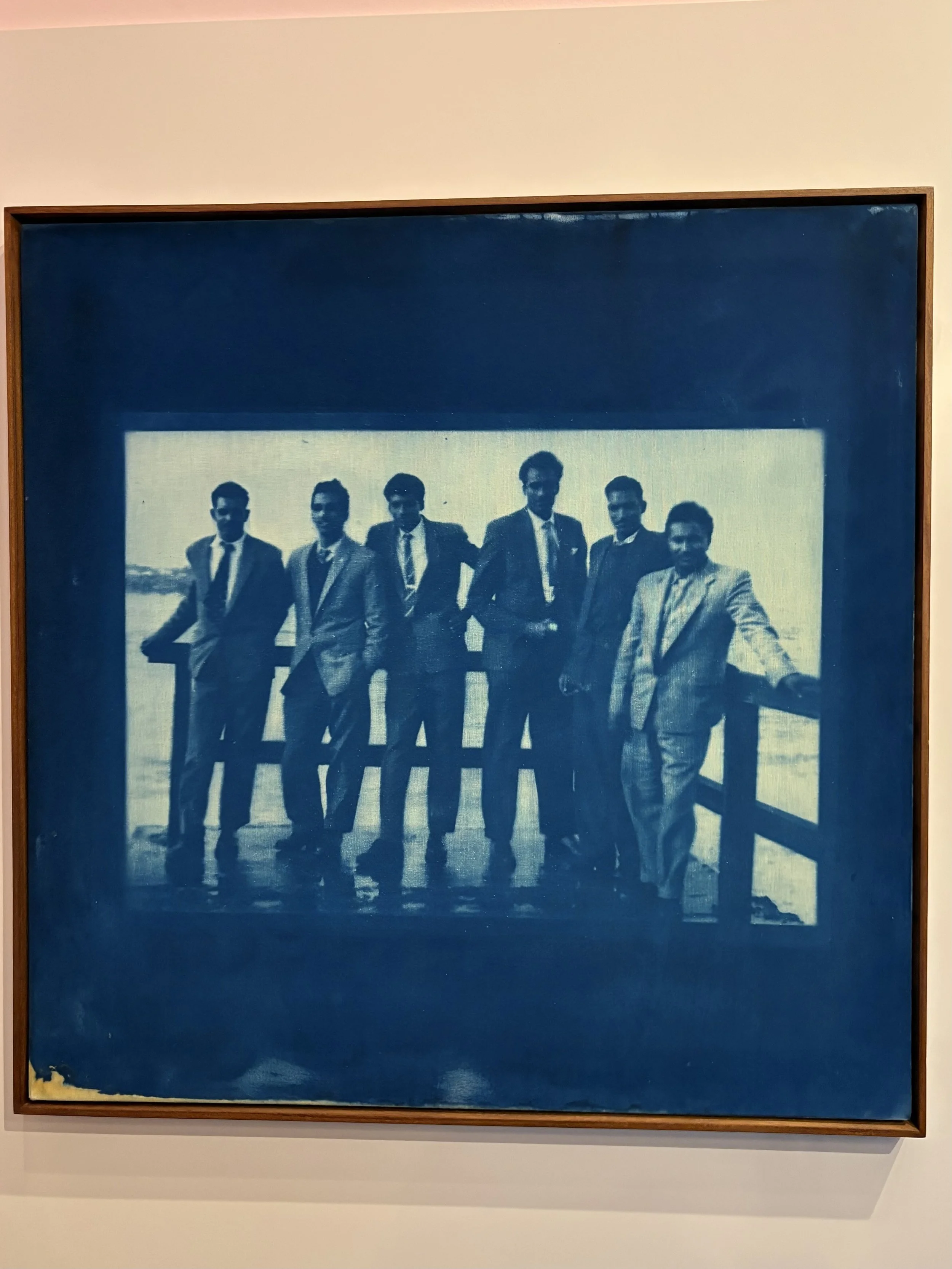
Alka Dass, “Uncles on the Whites Only Beach” (2023). Photo by Katya Shipyatsky.
The Old Town House Museum’s Reflections thus develops a vision of curation as contextualization and re-contextualization. The curator’s intervention is in which texts, histories, and other artworks accompany works from a collection like the Michaelis Collection. The curator’s political and ethical role comes in in her choice of context that either hides or makes visible the collection’s violent entanglements.
In the District Six Museum, however, we received a different vision of the roles and obligations of the curator. As TTTM co-investigator Ciraj Rassool notes, the District Six Museum occupies the distinct institutional form of what he calls the “community museum.”2 It is a “hybrid space of research, representation and pedagogy … where varied kinds of intellectual and cultural practices have been brokered and mediated between different sites, institutions and sociological domains.”3 The museum was born out grassroots gatherings where former residents of District Six met to share recollections of their former neighbourhoods and develop restitution strategies. The museum developed to support former residents’ land restitution claim under the Restitution of Land Rights Act.
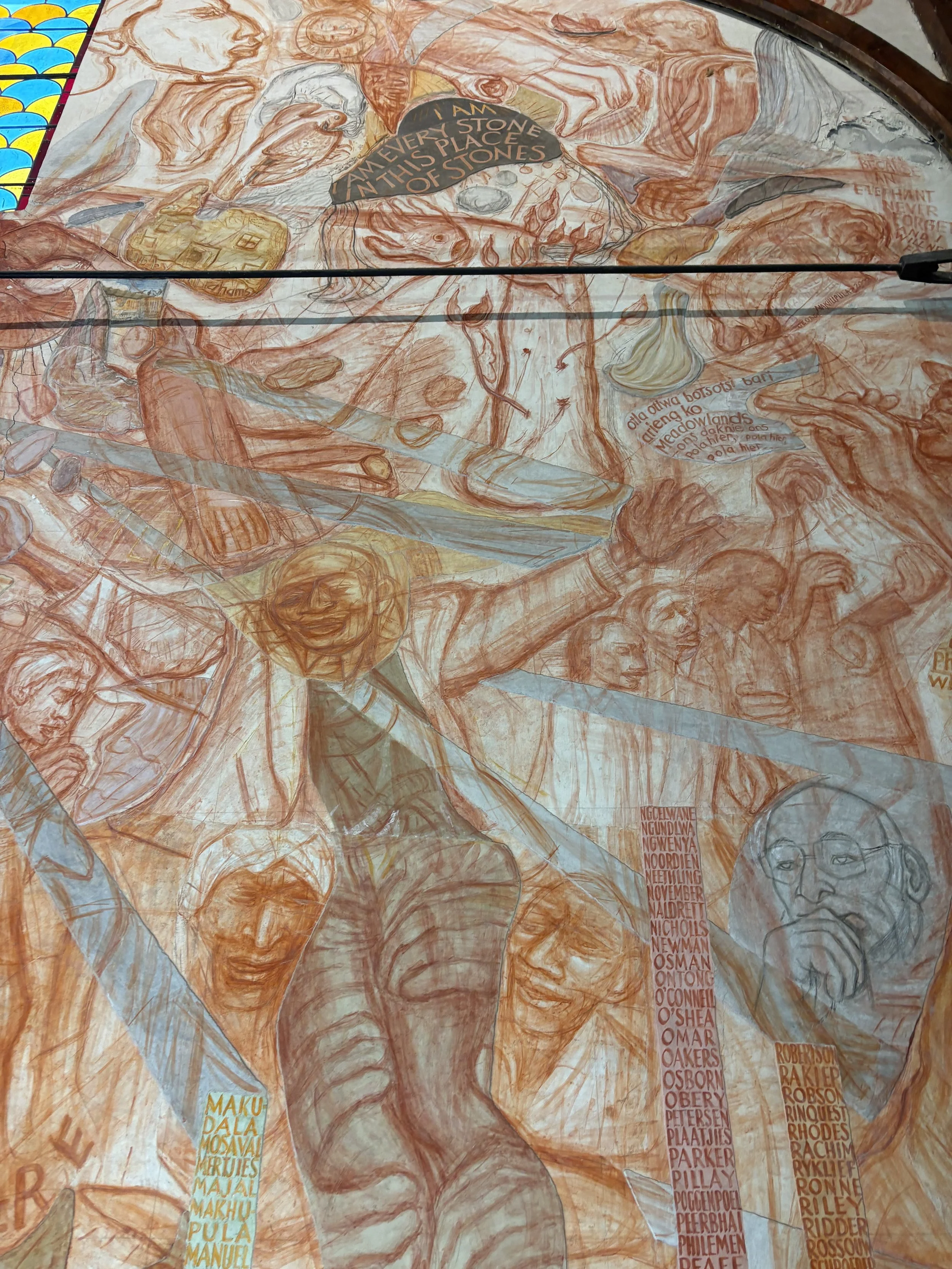
Peggy Delport, Detail from “No Matter Where We Are, We Are Here” (2006). Photo by Katya Shipyatsky.
The District Six Map – perhaps the most recognizable object in the museum’s collection – is a key example of the museum’s fusion of curatorial and activist practice. Originally used as a strategic tool for developing a land claims case, a map of District Six covering the floor of the museum became a space for former residents to annotate the places they used to live. Though now in storage, the map was the longtime centrepiece of the museum, anchoring its exhibition in the past and present struggle of former residents to lay claim to their neighbourhood.
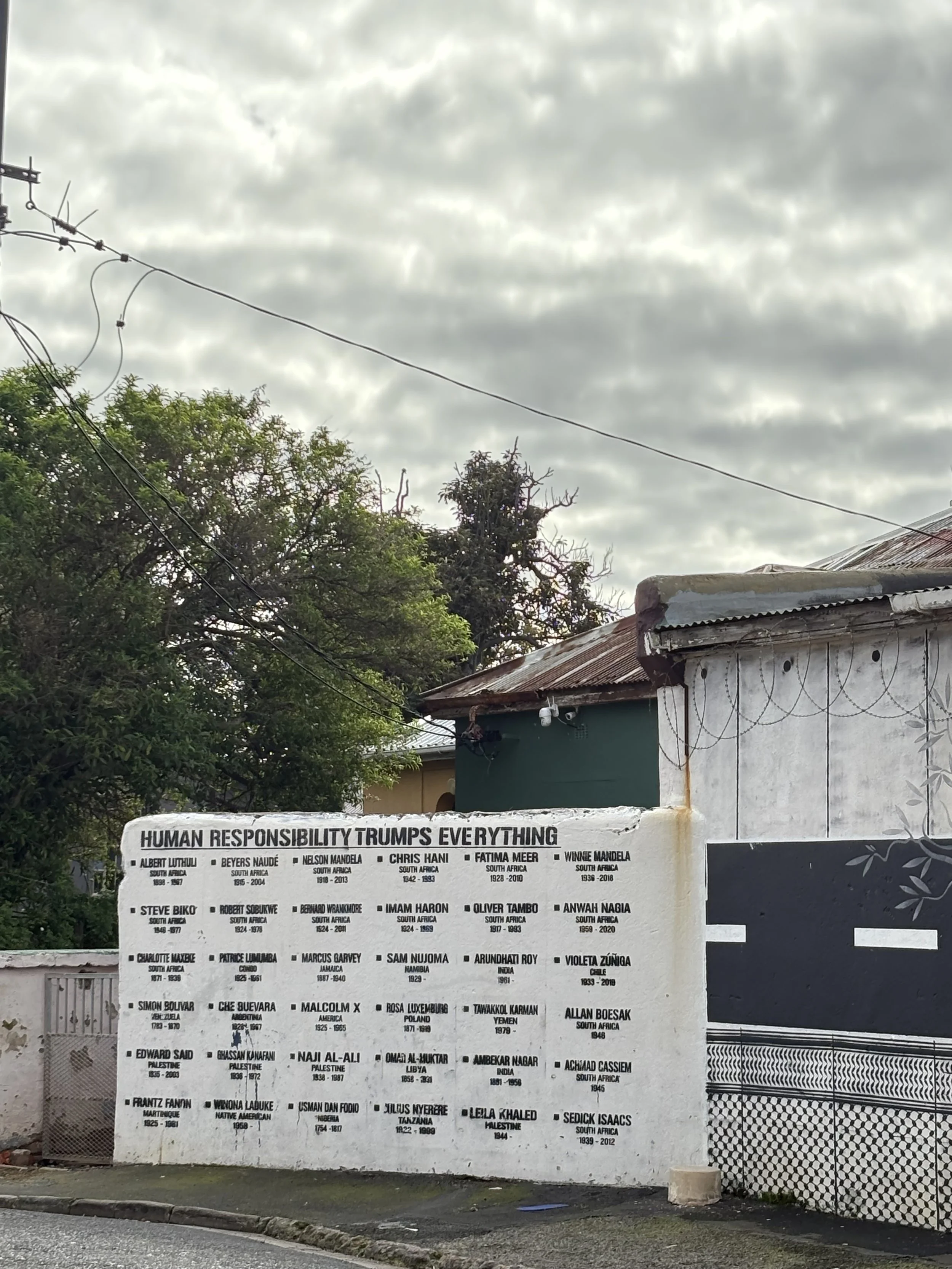
Detail from “Palestinian Roadmap” (The Wall 4 All), “Human Responsibility Trumps Everything” (2021). Photo by Katya Shipyatsky.
Like the District Six Museum, the Salt River Heritage Society (SRHS) uses curation as a tool in an ongoing struggle over land. The goal of SRHS is to “collect, collate and record the heritage, histories and traditions of the community based on its opposition to rank gentrification and forced removals.”4 SRHS responds to gentrification in the Salt River neighbourhood – corporate murals (2021), Amazon’s (successful) bid to develop its African headquarters in the neighbourhood (2024) – by using murals to visually and publicly assert longstanding presence and history in the Salt River neighbourhood. As Koni Benson and Thulile Gamedze put it, “walls, … when activated by the personal and political life of their site … can be part of social histories and public history practices, informed by anti-colonial work, communal care, and solidarity in resistance to the forces of capital accumulation.”5 Understanding the walls of Salt River as a battlefield, the SRHS curates murals and walking tours of the neighbourhood in order to produce a public, visual social history in opposition to the corporations laying claim to the land.
For both the District Six Museum and the Salt River Heritage Society, curation is political struggle. The practice of collecting and narrating art, objects, and stories to the public, emerges as a tool to use in a political struggle against colonial domination and its enduring corporate afterlives in the present. Curation – whether practiced inside the museum or outside of it, on streets and walls – is a means through which to build power and solidarity. The curator is not outside of political struggle, but a key player in it.
Together, the Old Town House branch of the Iziko Museum, the District Six Museum, and the Salt River Heritage Society present all of us who practice and study curation with multiple provocations: What is curation? How does the curator use her authority to contextualize what we see? And what we don’t see? What is the role of the museum – and of the curator – in ongoing political struggles against colonial legacies and corporate domination?
Works Cited
Andrea Lewis and Andrew Lamprecht, “Welcome and Tour of Old Town House Museum,” Thinking Through the Museum 2026 Annual Gathering, Old Town House Museum, July 24, 2026.
Ciraj Rassool, “Making the District Six Museum in Cape Town,” Museum International 58, nos. 1–2 (2006): 10-11, https://doi.org/10.1111/j.1468-0033.2006.00546.x.
Koni Benson and Thulile Gamedze, “Salt River’s Wall Wars: Forging Solidarities Through People’s History,” Africa South Art Initiative, September 10, 2023, https://asai.co.za/salt-rivers-wall-wars-forging-solidarities-through-peoples-history%ef%bf%bc/
Benson and Gamedze, “Salt River’s Wall Wars: Forging Solidarities Through People’s History.”