
BY EM PENNER (Research Assistant - Museum Queeries Cluster)
October 28, 2026
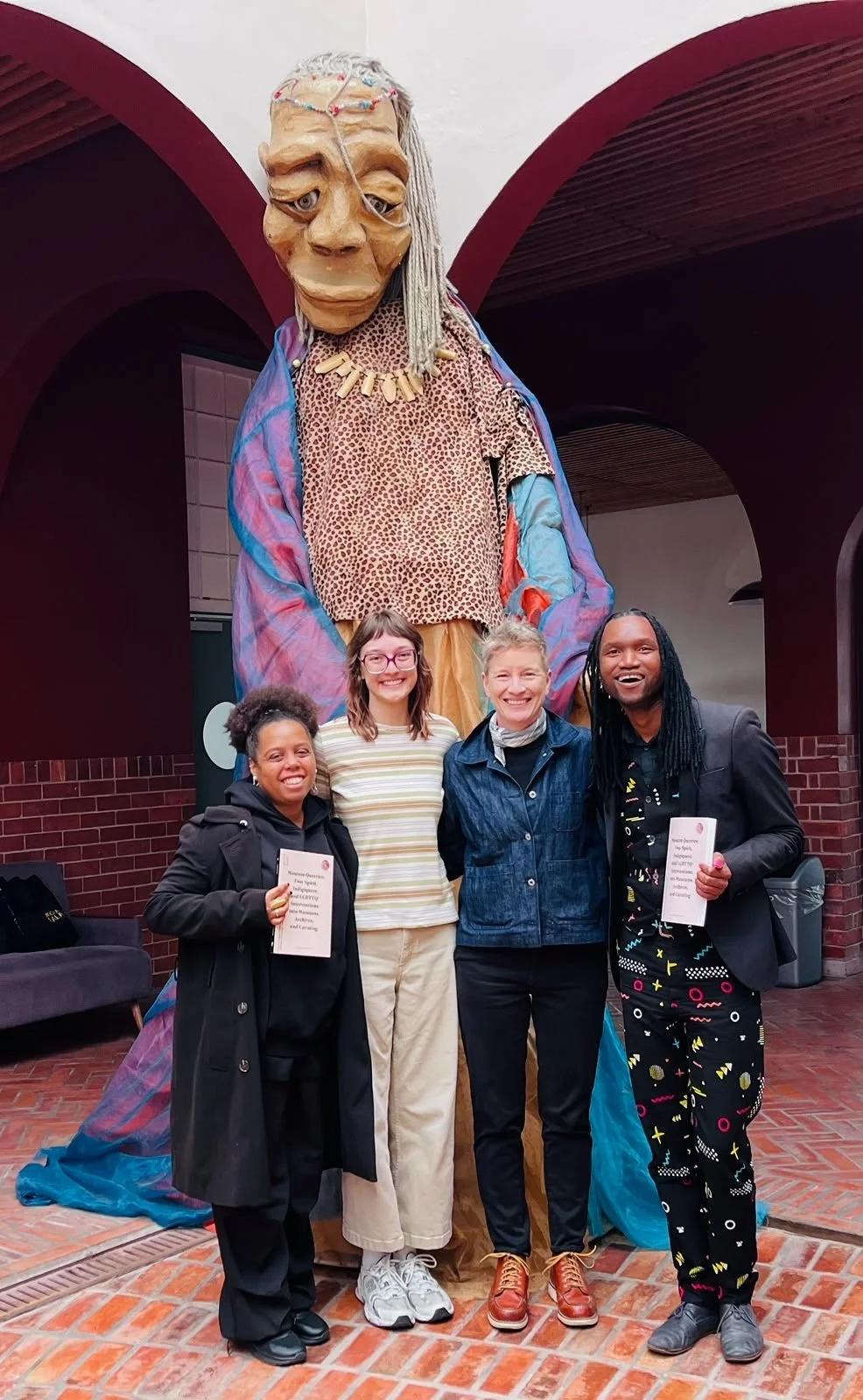
(From left to right) Arafa Hamadi, Em Penner, Angela Failler, and Lwando Scott holding copies of the Museum Queeries Edited Volume “Museum Queeries: Two-Spirit, Indigiqueer, and LGBTTQ* Interventions into Museums, Archives, and Curating”.
During my trip to Cape Town, South Africa for the TTTM Annual Gathering as a Museum Queeries Research Assistant, I found myself thinking about my relationship to the land and finding connection to queerness. As a reconnecting Indigiqueer Cree who has never left North America, being on a different continent where I was a visitor was a new, exciting, and uncertain feeling for me. I appreciated the folks who greeted our TTTM group warmly upon our arrival. I was grateful to hear stories of the history of the land, the Indigenous peoples, the culture, and the community from those who held them with care, and who graciously shared them with us as outsiders. I believe it is crucial to learn about the land you stand on from educators, storytellers, and community members to give it your utmost respect.
I found various connections to queerness in the art we saw, the discussions we heard, and the people we met. One instance of queer connection was a group visit to the Iyatsiba Lab at the University of the Western Cape (UWC), where we heard Dr. Lwando Scott, a Senior Researcher at the UWC, give a presentation about “Queerness, Blackness, and the Postcolony”. Scott discussed thinking about the “disarticulation between gender, sexuality, and race in post colony politics,” coining the term “queering the postcolony.” This is especially important regarding the idea of South Africa’s reframing as the “Rainbow Nation” following the first democratic election post-apartheid in 1994, intended to unify the country in their diversity (Sizemore-Barber, 3). However, the reality of equality and acceptance of diversity is highly critiqued, as this “metaphor of the Rainbow Nation is increasingly used by those within the new government to paper over corruption and inequality and to stifle dissent” (3). Scott explained this in relation to how anti-homosexual bills cast queer identities as “unAfrican,” allowing governing bodies to enforce particular ideals of how to “be” African.
Scott’s discussion of government regulation on gender and sexuality of African Indigenous peoples resonated with me, especially after relating this discussion to our visiting group’s perspective of regulatory frameworks on North American Indigenous peoples’ bodies. I thought this was a great way to bring attention to these similar white supremacist colonial tools of regulation on Black and Brown bodies on two different continents, especially through disproportionate violence toward queer and gender-diverse folks and women, through attempts of eradicating traditional, cultural diversity.
Another point of queer connection occurred at the Zeitz Museum of Contemporary Art Africa (MOCAA), where Museum Queeries met Arafa Hamadi, who was completing a fellowship concurrently with Zeitz MOCCA and the University of the Western Cape supervised by Dr. Scott. Hamadi is an interdisciplinary artist and curator based in Tanzania and Kenya with a background in Architecture, exploring “world-building in both digital and physical realms” (“Zeitz MOCAA & UWC”). Their work involves the relationship between queerness, space, and occupancy, and focuses on queer joy and connection through community such as art, exhibitions, and Ballroom culture in East Africa (“Zeitz MOCAA & UWC”).
We also viewed a beautiful queer short film called Over the Rainbow (2016-2017) by Athi-Patra Ruga as part of the Sala exhibition at the Zeitz MOCAA. It features a person wrapped in cloth bandages slowly being unraveled by five people, each donning rainbow-coloured, sparkly tulle, to finally reveal the individual wearing full glam makeup and undershorts, standing openly and alone; having shed their confining layer to transform into their true, unrestrained self. Ruga is a queer artist, filmmaker, and performer from the Eastern Cape, South Africa, who uses drag, queerness, performance, and mythical world-building in conversation with social politics to challenge post-apartheid South Africa and the idea of the Rainbow Nation (“Sala: Meet the Artists”).
It was so exciting to see such explicit queerness in the exhibition, that appeared empowering and positive. Queer joy, particularly Black, African queer joy is crucial in museum spaces—and beyond—because it shows a narrative that is meaningful, desirable, and necessary beyond victimhood and hardship.
Similarly, when I think of my own experience with Two-Spirit representation, I feel how crucial it is to have our stories heard as queer Indigenous peoples on Turtle Island and the African continent, that our lives have been important parts of our communities and lands, that our bodies are proof of our ancestors’ resilience, and that we can dream of a queer utopia that is colourful, joyous, and connected.
Works Cited
“Sala: Meet the Artists.” Zeitz Museum of Contemporary Art Africa, 12 Dec. 2023. https://zeitzmocaa.museum/exhibition/sala/. Accessed 31 Aug 2026.
Scott, Lwando. “Queerness, Blackness, and the Postcolony.” Thinking Through the Museum Annual Gathering. 22 Jul 2026.
Sizemore-Barber, April. Prismatic Performances: Queer South African Identity and the Deconstruction of the Rainbow Nation. 2013. University of California, Berkeley, PhD dissertation.
‘Zeitz MOCAA & University of the Western Cape (UWC) Welcome 2025 Museum Fellowship Cohort.” Zeitz Museum of Contemporary Art Africa, 7 Feb. 2025. https://zeitzmocaa.museum/exhibition/zeitz-mocaa-uwc-welcome-2025-museum-fellowship-cohort/. Accessed 6 Oct 2026.