
BY CANDIDE UYANZE (Research Assistant - Children’s Museology Cluster & Managing Editor - Critical Race Museology edited volume)
October 26, 2026
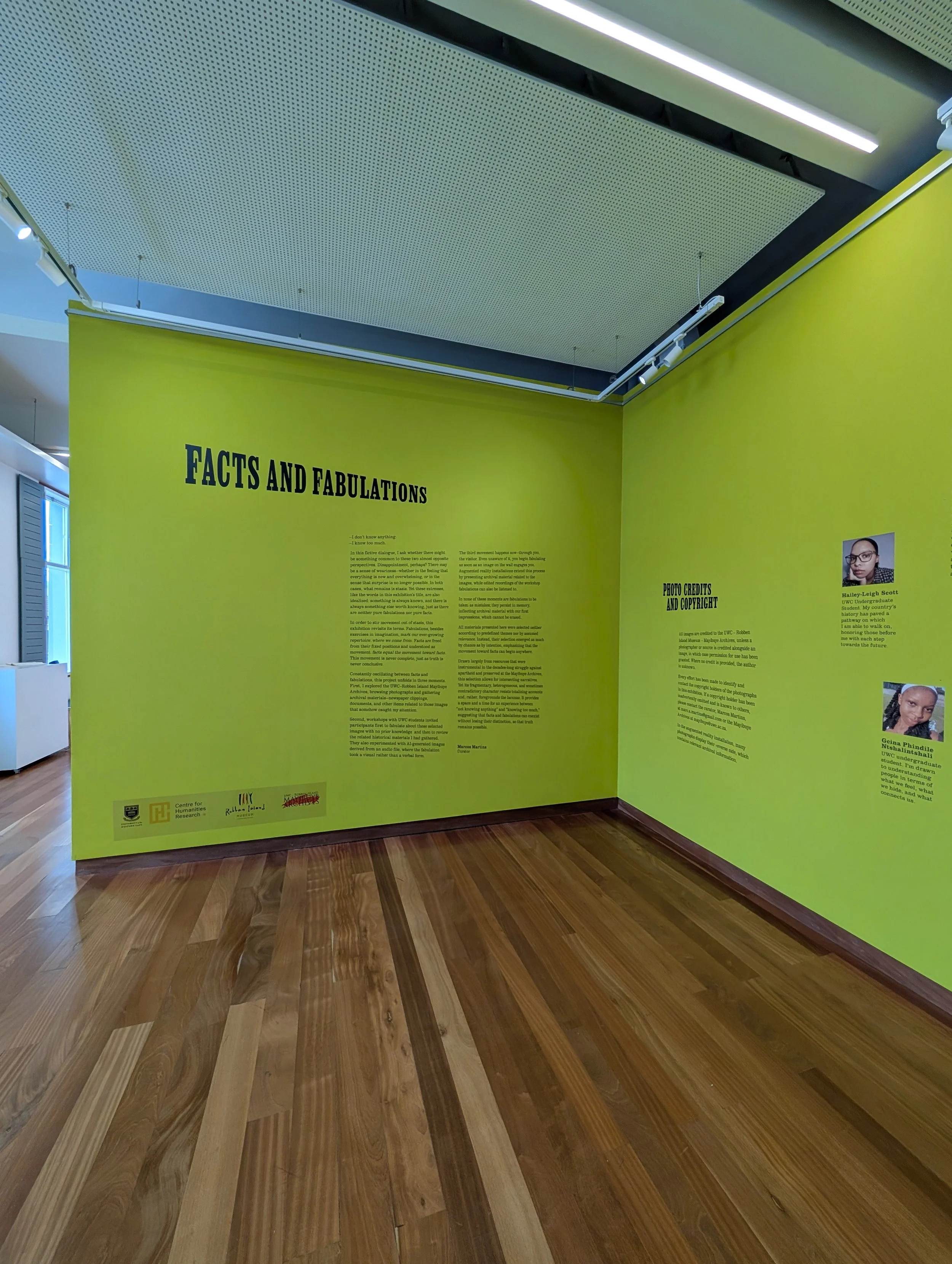
Photo by Candide Uyanze
What happens when you bring the experience of “not knowing anything” and “knowing too much” into an augmented reality exhibition? Facts and Fabulations, which opened on April 9th, 2026 at the University of Western Cape’s (UWC) Centre for Humanities Research’s (CHR) Iyatsiba Lab Gallery, explored just this and more.
This past July, 20+ members of Thinking Through the Museum (TTTM) had the chance to tour the exhibition in person and speak virtually with its curator, Prof. Marcos Martins, as part of TTTM’s annual meeting in Cape Town, South Africa.
“Fabulations”, as Prof. Martins defines it for this exhibition, mobilizes memory and imagination as an entry point to the journey toward “truth”. “Facts” begin with “Fabulation”, and are not ossified or immutable. They change all the time, and are understood as the movement towards “Facts”.
As a creative technologist from Canada, and in the spirit of this exhibition, below I’ve documented my insights, thoughts, imaginations, “Fabulations”, and movement toward “Facts” about it.
Some “Facts” about the exhibition, and my “Fabulations” during the experience
Facts and Fabulations, is the result of a year-long research project designed and conceptualized by Prof. Martins for the university’s Digital Curatorial Fellowship, as part of the New Archival Visions Programme. As a Brazilian scholar who came in knowing little about South Africa’s history, Prof. Martins began by consulting the UWC–Robben Island–Mayibuye Archives, a large multi-media collection depicting the struggle against apartheid and the vision for a just South Africa. Starting at the ground floor, he perused the photographic collections and selected photographs that caught his attention, were mysterious to him, piqued his imagination — caused him to “fabulate”, if you will. From there, he went upstairs and consulted documents, newspaper clippings, and other archival materials which contextualize the photos.
Afterwards, Prof. Martins held four full-day workshops with 11 undergraduate and graduate students from UWC (pictured below). He began the sessions by introducing the students to some of the photographs he had selected without context, inviting them to speculate or “fabulate” about the images. Later, he presented students with the archival documents he collected, and prompted them to compare their initial findings with their informed “fabulations”.
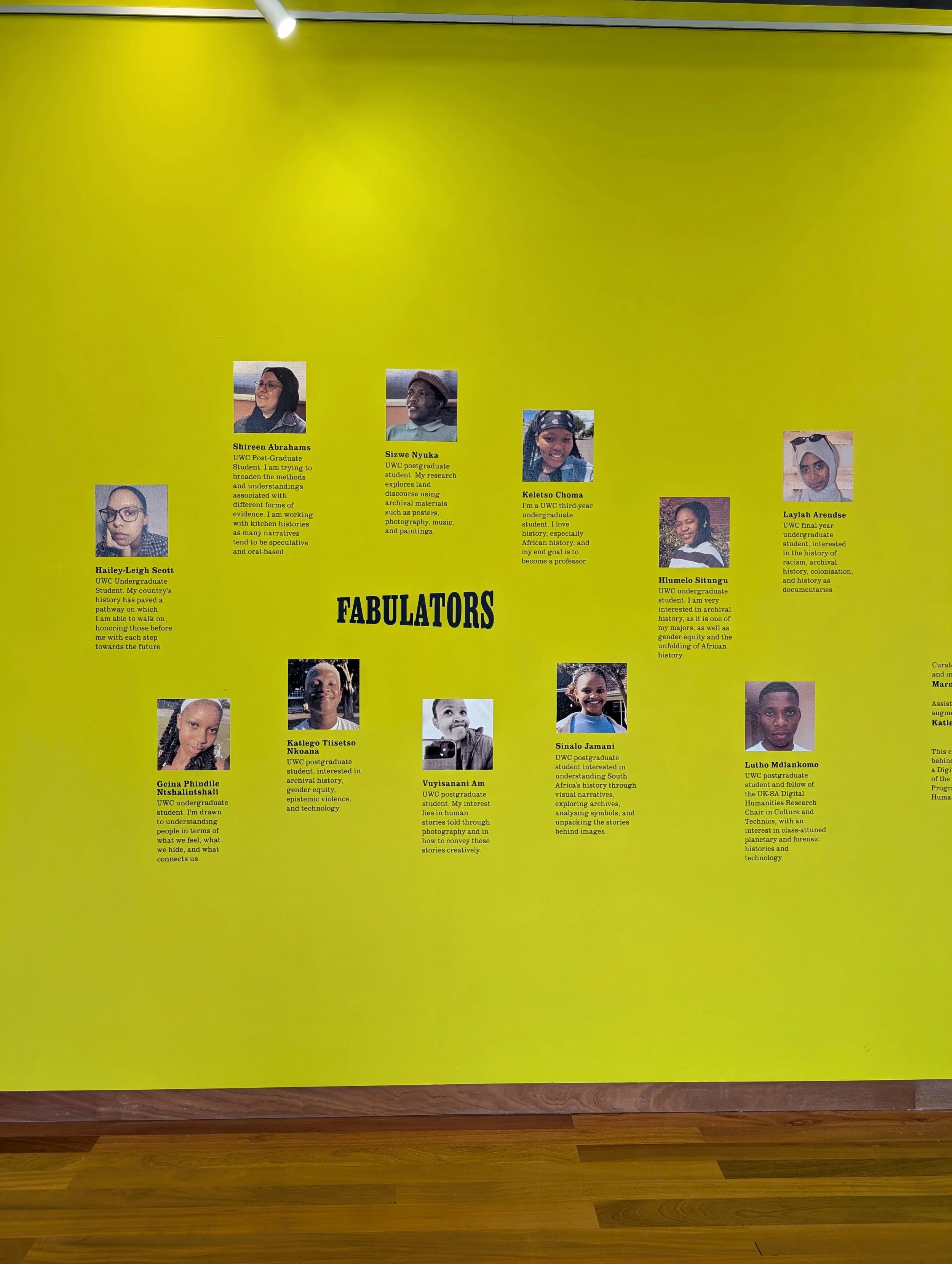
The 11 workshop participants (or “Fabulators”) were featured on the gallery wall by the entrance of the exhibition, along with their headshots and bios. Photo by Candide Uyanze.
The resulting exhibition features these initial photographs that Prof. Martins had selected. Instead of exhibit labels, each image is accompanied by two QR codes: on the left, an AR experience which included related archival documents and written excerpts from the workshops; on the right, a link to an audio recording hosted on Google Drive from the student “fabulation” workshops.
At the start of the tour, our workshop-participants-turned-guides, Hailey-Leigh Scott and Laylah Arendse, had us download the iOS-only AR app (or use one of their tablets) and instructed us on the very particular way to set up the experience for each photograph. We were then free to experience and explore.
Videos by Candide Uyanze.
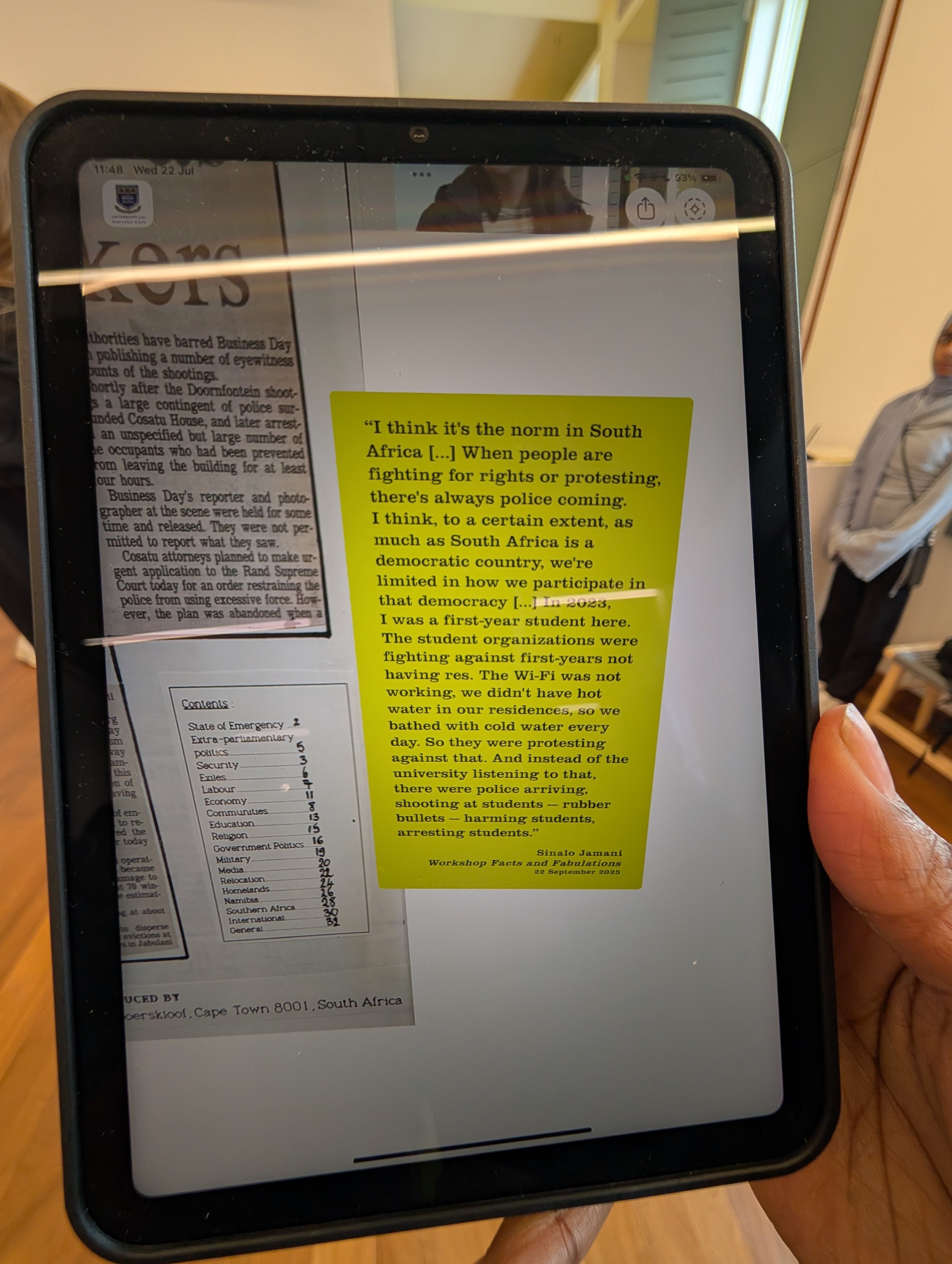
In the midst of the overwhelm, I captured a picture of one of my favourite digital panels from the exhibition. It echoed previous examples of police repression that I learned about in other museums and galleries that we visited in Cape Town. Photo by Candide Uyanze.
Despite the support of our fabulous “Fabulators”, I found myself overwhelmed, between:
having to hold up a tablet for an extended period of time,
making sure I set up the AR correctly for each photograph (lest the graphics appeared lopsided),
trying to decipher the very well-designed but very text-heavy virtual panels,
overhearing audio recordings playing from nearby devices,
making sure I didn’t bump into one of my fellow TTTM members, and
wrapping up within the allocated time.
At some point, I gave the tablet back and resigned to just look at the context-less photographs on the wall, snapping photos of each on my phone so that I could scan the QR codes later. Without headphones or captions, I had trouble following along with the audio recordings.
This blog post is a two-part series. Stay tuned for the release of part 2 in the coming weeks!