
Thinking Through Disruption at the District Six Museum
BY EMILY JENKINS-MOSES (Research Assistant - Children’s Museology Cluster)
October 6, 2026
On the morning of July 20th, 2026, Thinking Through the Museum members visited the District Six Museum as part of our Annual Gathering, "Building Democracy: Museums, Memory Work, and the Arts in Cape Town, South Africa." Here, we were able to discuss the museum’s history, trajectory, and priorities with those who have worked with the museum closely for decades. One of the first sentiments shared with us by our guide, Tina Smith (Exhibitions Manager), was that the District Six Museum is not stuck within the confines of its academic depictions. Smith, who has been involved in the curation of the museum since its inception in 1994, noted that, as one of the most influential community museum case studies, the District Six Museum evoked specific pedagogical expectations in visitors. And she was right, at least in my case.
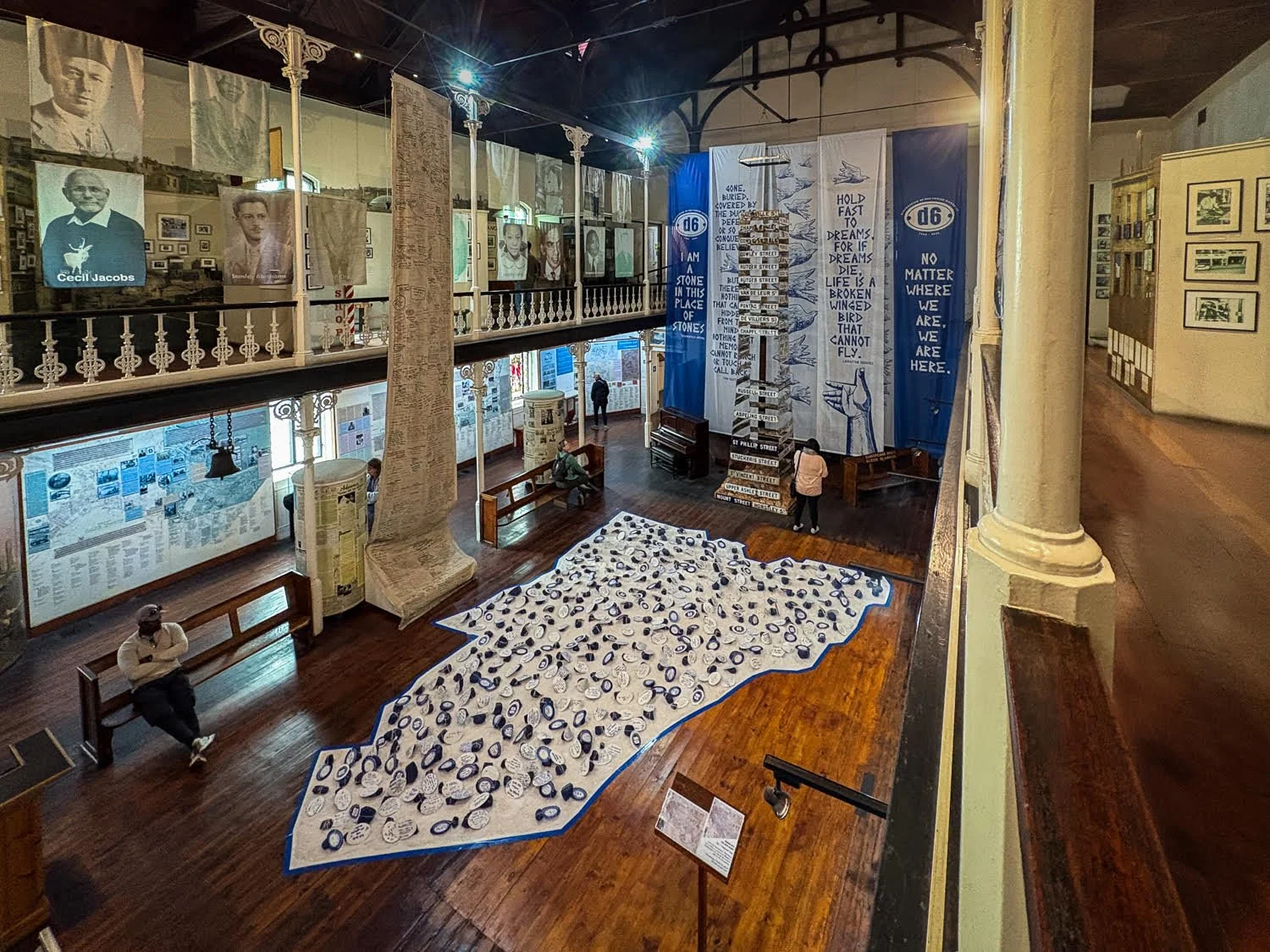
View from inside the District Six Museum.
I first learned about the District Six Museum in a graduate museum anthropology seminar at California State University, Chico in 2022. The class was reading Elizabeth Crooke’s 2005 article “Dealing with the Past: Museums and Heritage in Northern Ireland and Cape Town, South Africa.” In it, Crooke writes that the District Six Museum, as a community museum structured around memory, self-determination, and anti-erasure, exemplifies the “power and importance of a museum” (2005, 136). She notes that, unlike traditional institutional framings of a museum, the District Six Museum emphasized its dynamism from the beginning, not as a source of fixed or static information, but as a space of transformation.
Despite never presenting itself as a static institution, certain elements, such as its floor map, became fixed in the academic and scholarly imagination of the District Six Museum’s identity. The large interactive floor map, which has been the focus of multiple case studies, allowed ex-residents to plot their memories and histories across the map of a razed District Six, allowing the community to reclaim place, collect stories, and reify connections (McEachern 1998; Rassool et al. 2001). Although Crooke herself does not mention the floor map, I learned about it sitting in my seminar classroom. These elements of visitor engagement were so embedded in the image of what the District Six Museum is that our professor created a supplemental PowerPoint to highlight them. And these elements became part of my expectations for what I would see during my visit.
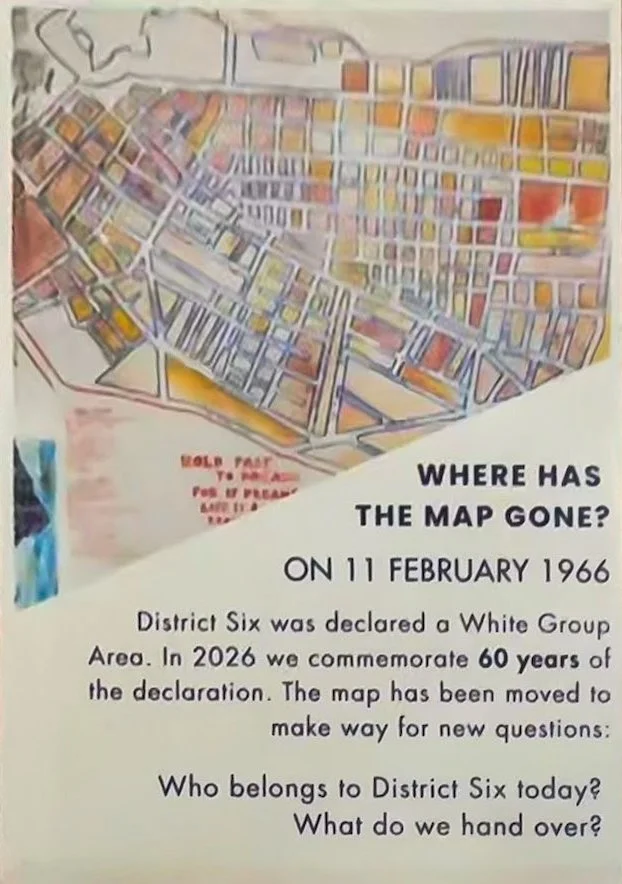
A sign at the District Six Museum explaining the absence of the floor map.
So, walking into the museum, I was surprised, and a bit disappointed, not to see the map. And I was not the only one. Smith shared that there has been an outcry by some visitors regarding its removal. Despite this, she said that it was time, claiming that the map was “only meant to last two weeks” but instead “lasted 32 years.” Not only was the map difficult to conserve, but it also anchored the museum space to a specific set of priorities that were less relevant three decades later. She shared that it was time for a “disruption” and to move beyond the “frozen” account of what public engagement at the District Six Museum looks like.
Smith shared that over the years, the museum’s demographic has shifted increasingly from survivors of the forced removals to individuals who have no living memories of District Six before residents’ eviction. Although still working with descendants, this generational shift, coupled with digital advancements and looking towards the future, has sparked a new focus on understanding who, in the present, “belongs to District Six.”
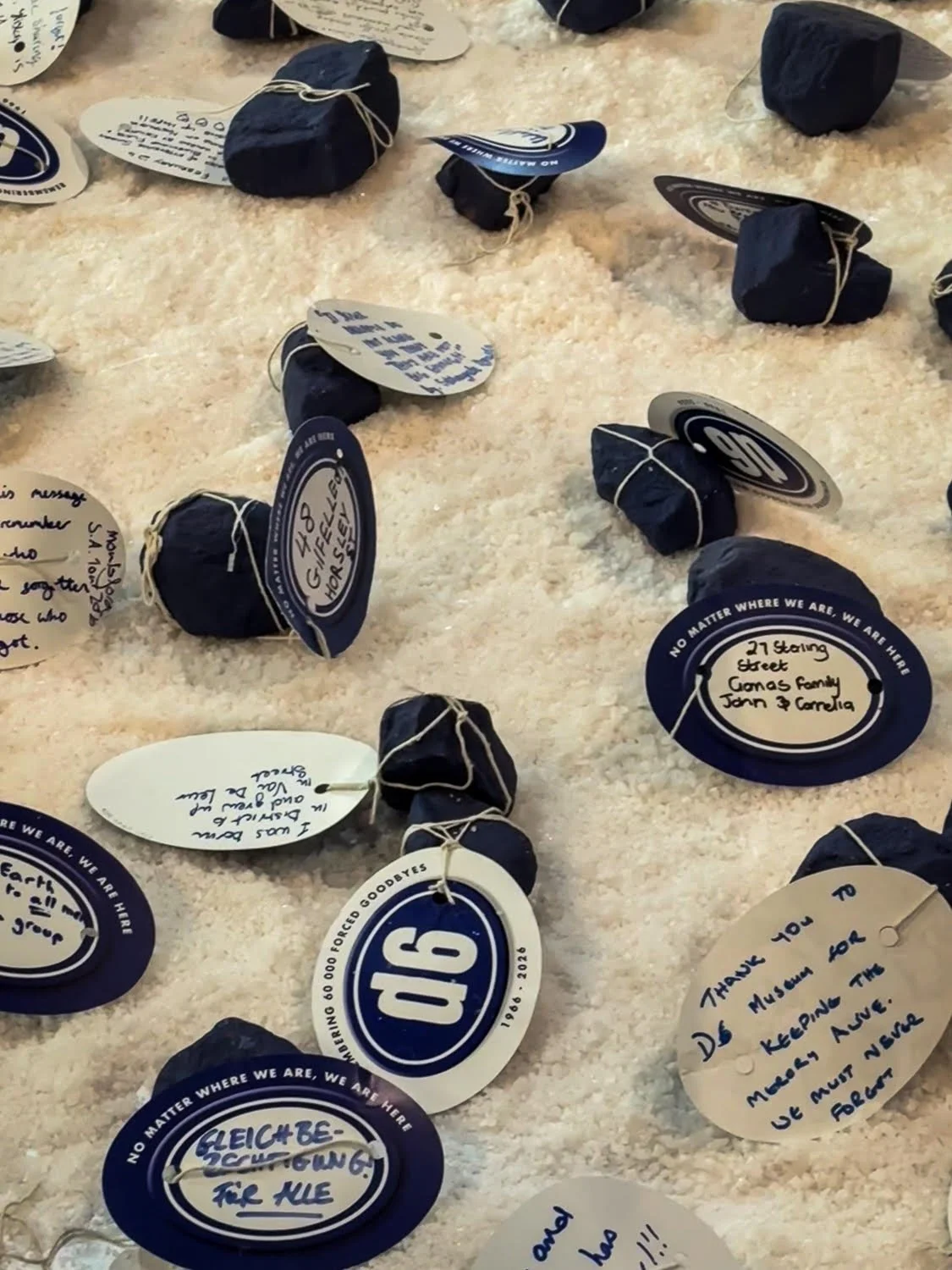
A closeup of the current floor exhibit at the District Six Museum.
In the footprint of the former map lie hundreds of stones nestled in salt crystals. Tied around the stones are message cards, some designed for visitors and others for ex-residents. Whereas visitors were prompted with questions of belonging and what should be “handed over” to the next generation, ex-residents wrote their names and where they had lived in District Six. Together, these messages highlight the museum’s current transition: still serving as testimony of those who had lived in District Six before and during apartheid, but also looking towards how these memories and legacies shape the present and future of District Six.
Although core elements of the District Six Museum have not changed, such as a commitment to community, Smith highlighted the way in which certain priorities have. These changes, and my surprise at encountering the physical manifestation of them, such as the removed floor map, made me think about another lesson I learned sitting around a seminar table in Chico. Specifically, the power of exhibitions to make culture appear static to onlookers and the impact this can have on cultures themselves. In this case, it was a museum that was frozen due to its depiction in literature.
Perhaps this has occurred to many people already, but it was not until this moment that I explicitly recognized that museum literature can have the same effect on museums as museums can have on culture. I wonder, would the “disruption” that Smith mentioned be as critical if the map never became synonymous with the museum itself? What new stories can be told now that the District Six Museum has pushed beyond the collective image the world has of it?
Works Cited
Crooke, Elizabeth. “Dealing with the Past: Museums and Heritage in Northern Ireland and Cape Town, South Africa.” International Journal of Heritage Studies: IJHS 11, no. 2 (January 2005): 131–42. https://doi.org/10.1080/13527250500070329.
McEachern, Charmaine. “Mapping the Memories: Politics, Place and Identity in the District Six Museum, Cape Town.” Social Identities 4, no. 3 (October 1998): 499–521. https://doi.org/10.1080/13504639851744.
Rassool, Ciraj, Sandra Prosalendis, and District Six Museum Foundation. Recalling Community in Cape Town: Creating and Curating the District Six Museum. Cape Town, South Africa: District Six Museum, 2001.