
DEAR DYBBUK
By: Hana Umeda
To increase the visibility of non-White / non-Catholic contributions to Polish culture and heritage, TTTM’s National Heritage and Traumatic Memory cluster offers an annual minority artist’s residency at Polin Museum in Warsaw, co-sponsored by Partner Organizations FestivALT and Teatr Powszechny.
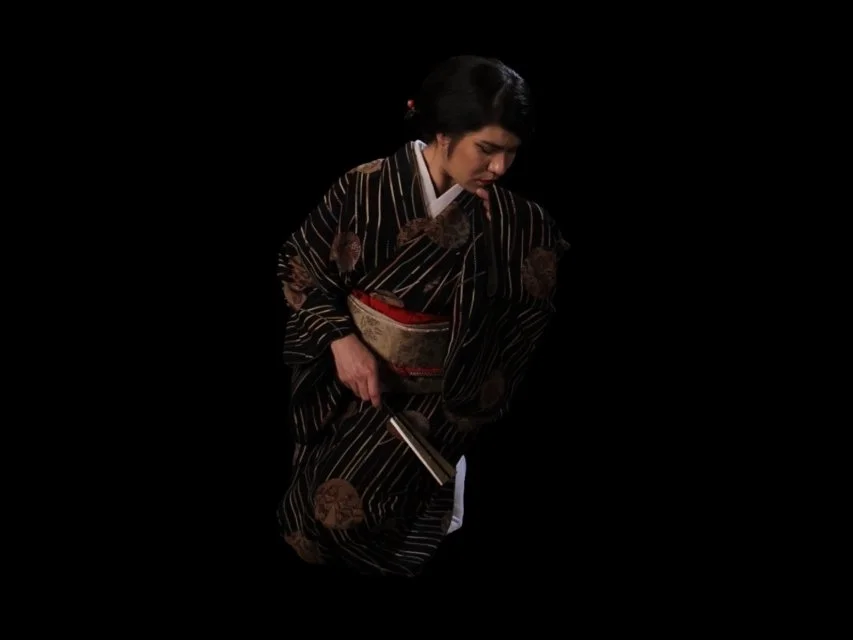
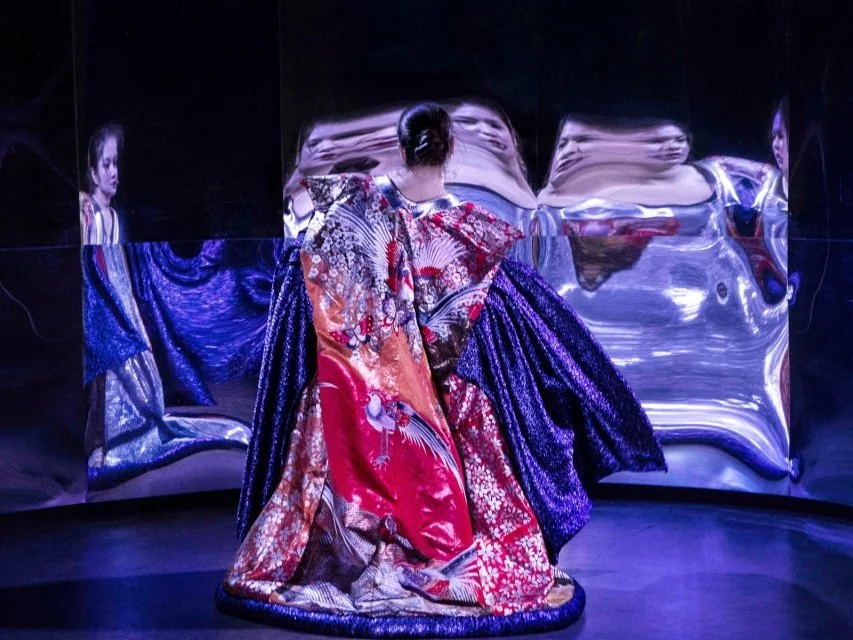
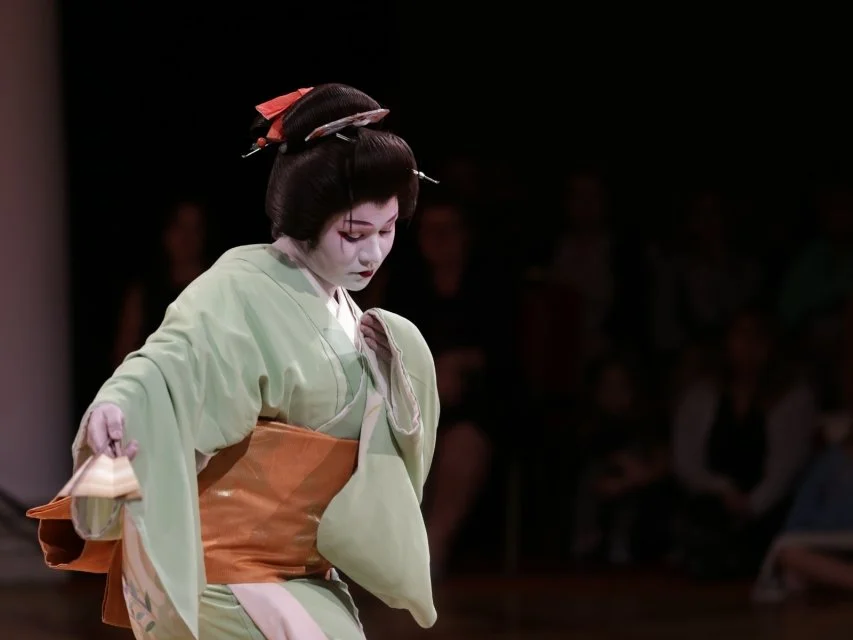

I imagine what it’s like to be possessed by a dybbuk. Someone violently invades my body. It feels as if I was dying. I want to scream but my voice is strangled and only a hoarse or thin squeak emerges. A little voice, a child’s voice. I know I should defend myself, but my muscles refuse to cooperate. Perhaps it’s for the best, otherwise he might have killed me. I lay down on the ground, lifeless, and my body is no longer mine. Somehow, my identity and psycho-physical integrity vanish. I lose control. Who is this? What’s his name? I don't know, or perhaps I’d rather not say. I feel guilty. Maybe I did something to provoke him. Maybe my body sensed some kind of pleasure, utterly against my will. I feel impure. Everyone knows I’m impure. I don’t know what’s happening to me. I disappear. I’m not here. I’m not here at all.
The word dybbuk comes from the Hebrew root דבק (dovek) meaning “to adhere, to cling.” It is an abbreviation of the expression dibuk me-ruakh ha-ra, lit. “clinging of a malevolent spirit”— it refers to a stray soul that has taken possession of a living body.[1]
I am a living grave. Someone or something moves my body, speaks words for me in a voice I do not recognize. Psychology calls such a state ‘dissociation’—it often occurs after experiencing rape. But how would a simple girl from a shtetl know the consequences of experiencing sexual violence? In the accounts of possessions by a dybbuk cited by Yoram Bilu,[2] there are suggestive descriptions of such violence. An eleven-year-old girl living in Jerusalem in the nineteenth century confesses that during a possession she was pushed, fell over, her lying body was forcibly turned over. A young Jewish woman living in Baghdad in the early twentieth century describes how something threw itself at her hips and, at the same time pressing against her shoulder blades, forcibly entered her. Eli Somer[3] notes that in sixteenth-century legends about dybbuks, there are suggestions that the evil spirit enters the body of a living victim through a vagina or an anus, which leads one to believe that we are indeed dealing with rape. Rachel Elior seems to agree with this hypothesis, even if she also sees the opposite gesture in possession, related to escape or protection from this type of violence.
Stories of exorcising dybbuks and clinical assessments of hysterical states suggest that the “spirit” could serve—simultaneously—as an expression of harassment, intimidation, and sexual exploitation of women by men which, typically, was ignored and trivialized by the community, and as the only way for women to escape such enslavement.[4]
According to Elior, the fear associated with being forced into an arranged marriage and, consequently, the prospect of unwanted sexual contacts could induce in young women a kind of mental disorder similar to hysteria, which was interpreted as possession. In both cases, we are dealing with sexual trauma.
I am comparing descriptions of dybbuk possessions with my own memory of the state I found myself in after experiencing rape.
The stories of dybbuks and the reports of their exorcisms suggest that the primary symptoms of possession by the spirit were, on the part of the victim, a loss of control over their own body and the sound of a foreign voice coming from their mouth. The afflicted person was lying down, appeared to be immersed in sleep or dead, unable to control their body and thus, it seemed, also unable to speak.[5]
The worst of all was the feeling of lack of control. The frozen body regained the ability to move freely after a few days, the voice that got strangled, making it impossible to scream and call for help, eventually returned to its normal timbre. And yet, the sense of loss of control—despite repeated, strenuous attempts to regain it—lasted for the next seventeen years. In an effort to regain control, a person who has experienced rape reconstructs the event as long as they fail to regain that control. This can be done in many different ways: for some, it will be putting themselves in a similarly risky situation, in order to behave differently this time round. Some people strike up a relation with their rapist. Others reproduce humiliation or objectification in situations seemingly unrelated to rape. With appropriate and quickly applied psychological help, it is entirely possible to avoid the long-term effects of rape. However, despite widespread psychotherapy, access to it is not all that obvious. Sometimes it seems to me that our situation is not altogether different from that of women possessed by dybbuks.
Trauma therapy is expensive and not everyone can afford it. Many psychotherapists do not have the tools to work with sexual violence. Rape is still a taboo and often we do not find the language to talk about our experience. Initial reactions also count. Shame and guilt can be intensified by the reactions of our surroundings. Sometimes it is easier to resort to denial than to confront one’s own trauma. Many cases of sexual violence do not fall under the still prevailing definition of rape in Poland, which expects victims to actively resist, not taking into account the natural freeze response. An unprocessed rape can inhabit our bodies for years like a parasite, and even attack subsequent generations who inherit trauma just as many of us have inherited trauma from our mothers and grandmothers. I call this parasite a dybbuk.
I wonder if the ritual of exorcising a dybbuk could become a framework for freeing oneself from the trauma of rape in today’s world as well.
The body possessed by a dybbuk became a stage on which a battle was waged between holy names and unclean powers. [...] The ritual was conducted in a synagogue, where a prayer quorum of ten men (a minyan) had to gather, obligated to purify themselves beforehand through fasting and a ritual bath. They were all clad in white robes (a kitl — garment also worn during Yom Kippur, the Day of Atonement), over which they threw prayer shawls and put on phylacteries. The Ark — aron ha-kodesh — was opened. At the same time, the sound of seven ram’s horns — shofars — resounded while seven Torah scrolls were taken out from the Ark. Seven black candles were lit, and the Ark itself was covered with a black curtain. Incense was burned and the recitation of spells, curses, excommunication formulas began, aimed at warding off demons and evil spirits. The entire assembly unanimously repeated the curses and formulas, as well as the poem— Psalm 91, an ancient prayer recognized for its anti-demonic power. Then various combinations of the divine name consisting of forty-two letters were recited, which included kera’ satan, meaning “tear Satan apart,” “destroy Satan.”[6]
As a performer, I find clear guidelines in the description of such a ritual. First, I expose my body to the public eye. Second, I make a clear and decisive accusation. I pronounce the name of the person who hurt me. The community to which I belong supports me in this rite of passage. Since I am not a religious person, this community will not be a congregation; I will not ask for the help of a rabbi, and the prospect of undergoing a ritual conducted by men alone seems to carry a potential for re-traumatization rather than liberation.
I conclude my residency at the POLIN Museum with a question: How to translate the dialogue that is the basis of trauma therapy into the language of a contemporary exorcism ritual? I set out in search of a stage, a community, and spells that will have the power to expel the dybbuk.
References
[1] Agnieszka Legutko, „Opętani opętaniem: motyw dybuka w literaturze żydowskiej,” [in:] Dybuk. Na pograniczu dwóch światów, ed. Mieczysław Abramowicz, Jan Ciechowicz, Katarzyna Kręglewska, National Museum in Gdańsk, University of Gdańsk Publishing, Gdańsk 2017, p. 131.
[2] Yoram Bilu, “The taming of the Deviants and Beyond: An Analysys of Dybbuk Possession and Exorcism in Judaism,” [in:] Spirit Possession in Judaism. Cases and Contexts from the Middle Ages to the Present, ed. Matt Goldish, University of Pennsylvania Press, Detroit 2003.
[3] Eli Somer, “Trance Possession Disorder in Judaism: Sixteenth-Century Dybbuks in the Near
East,” [in:] Journal of Trauma & Dissociation, vol. 5, 2004.
[4] Rachel Elior, Dybuki i kobiety żydowskie, Wydawnictwo Poznańskiego Towarzystwa Przyjaciół Nauk, Poznań–Gniezno 2014, p. 69.
[5] Ibid., p. 71.
[6] Ibid, pp. 93-94.