
This blog post is a two-part series. You can read part 1 here.
BY CANDIDE UYANZE (Research Assistant - Critical Race Museology Cluster & Managing Editor - Critical Race Museology edited volume)
November 9, 2026
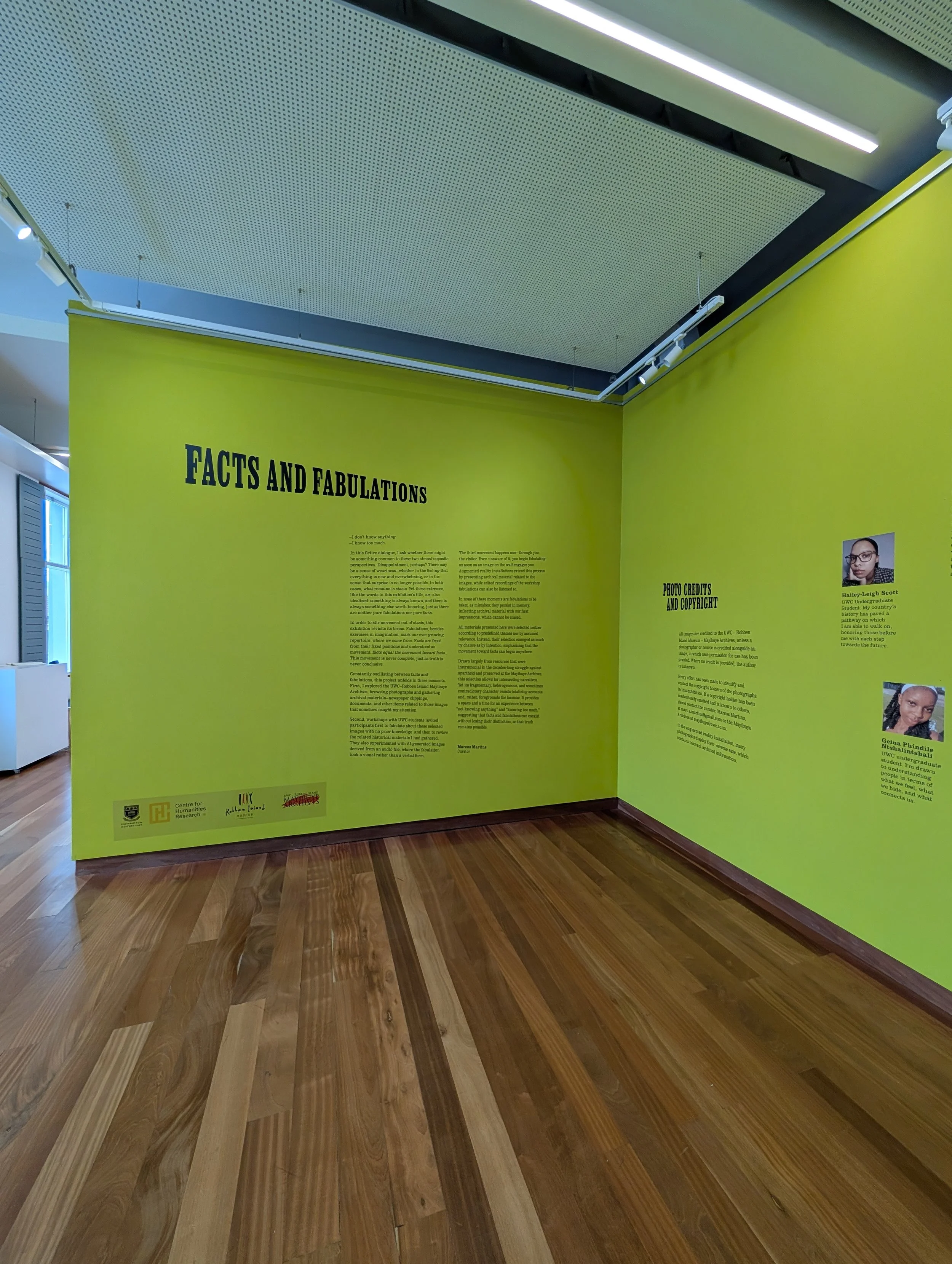
Photo by Candide Uyanze.
The “Facts” I gathered after the exhibition, and some continued “Fabulations”
After visiting the exhibition, we attended a virtual presentation by Prof. Martins, where he talked about his process, and where I learned that one of the images in the exhibition was generated using artificial intelligence (AI). The AI image was created based on a recording from the Mayibuye Archives, with the help of the student “Fabulators”. Although this admission brought up a multitude of ethical questions, I, instead, used my Q&A opportunity to ask about the process of selecting the AR software, and why that particular tool was chosen. Prof. Marcos explained that he settled on JigSpace to leverage the university’s existing subscription and because it was easy for him to use and easy to teach to students.
Dissatisfied with Prof. Martins’s answer, I set out to write this blog post to explore how the technology could have been better implemented, but decided to dive deeper. Maybe I was missing something, as a cultural, relational, and academic outsider...
To move closer to the “Facts”, I:
looked into low-cost AR apps and frameworks that worked across devices and didn’t require an app;
did some light research on best practices for AR use in exhibitions, and learned about the frictionless AR rubric for museums;
read “Venus in Two Acts” by Saidiya Hartman (2008) for the first time (where the term “Critical Fabulations” is coined);
consulted web pages about the exhibition from the CHR’s website;
re-watched the photo and video documentation I took;
used said photos to scan the QR codes I hadn’t consulted to listen to the recordings and view some of the augmented elements properly;
etc.
Understanding this, I would have much preferred for the tour to begin with our own “fabulations,” instead of having devices introduced from the start.
Things didn’t really start to click, however, until I watched “Moving Between Facts and Fabulations”, a lecture by Prof. Martins that was filmed before, but published a month after, our Cape Town meeting. As I watched it, the intentions of Facts and Fabulations became clearer. For this exhibition, Prof. Martins re-enacted his own process of moving from a position of not-knowing, to one of knowing, much like he did for the student workshops, but this time using AR to hide the context.
Understanding this, I would have much preferred for the tour to begin with our own “fabulations,” instead of having devices introduced from the start. Next, we could have taken time to listen to one of the recordings from the student workshops (ideally with headphones, but I later learned that this was out-of-budget). Or, the recordings could have been combined with the AR experience, to demonstrate what Prof. Martins called the intertwining of “facts” and “fabulations” as an empathetic bridge between past and present. This way, the visitor’s fabulations and sense-making become part of this third iteration. Instead, I felt more like I was witnessing and reliving other people’s “movements toward facts”, rather than experiencing my own.
In that lecture’s Q&A, Prof. Martins explained the exhibition’s text-heaviness as a desire to counter contemporary interactiveion design, which tells designers that user interaction should be so self-evident and intuitive that their users shouldn’t have to think too much before clicking (Krug 2000). He also shared that some of the Fabulators-turned-guides found the experience boring, and that he wanted to challenge that. I would argue, however, that this shouldn’t come at the expense of accessibility, legibility, and cognitive load. Perhaps this means that the panels in the AR experience should appear one at a time (or in smaller batches) as you move forward through the space. This way, the intention for people to physically move towards “facts” remains, without feeling overwhelmed.
Can AI “Fabulate”?
As I watched the video, I wondered (and still wonder), why the AI image was ultimately kept, how the opinions of other skeptical collaborators may have shifted throughout the project’s life, and whether the “epistemic violence” and IP infringement of AI was ever addressed.
The last media I consulted was the Facts and Fabulations Opening lecture in which Katlego Tiisetso Nkoana, a student “Fabulator” turned Assistant Curator, describes his initial disdain for Artificial Intelligence (AI). Nkoana recounts how, when Prof. Martins first pitched the project, he rolled his eyes at the mention of AI and described it as “epistemic violence” in the feedback form.
Later, Nkoana discusses his anxieties with including the AI-generated image in the exhibition, because he sees it as a dangerous tool that extracts someone’s intellectual property without compensating them. He continues, however, by wondering how AI can be ethically used to critically fabulate on memories that lack historical records or visual representations. As I watched the video, I wondered (and still wonder), why the AI image was ultimately kept, how the opinions of other skeptical collaborators may have shifted throughout the project’s life, and whether the “epistemic violence” and IP infringement of AI was ever addressed.
The last 10 minutes of the opening day video introduce the student “Fabulators” to the audience, who are later seen guiding these same audience members through the exhibition. The room is full — an even bigger group than ours, it seems — and we see clips of beaming faces making their way through the space and “fabulating” out loud. The conviviality and festivity is palpable. I wondered how each visitor, seen or unseen, felt throughout the exhibition. Did any of them feel the same way I did, in the same space, months later?
Conclusion
Despite some of my concerns with the implementation of the technology and lingering questions about some curatorial choices, I can appreciate the collaborative and participatory ethos of this exhibition’s development process, and I’m curious to see how this concept will be developed in a future iteration. The rest, well, can be left to future “fabulations” and facts-seeking.
Much like the research project and exhibition’s overarching intention, I came out of this process knowing a little bit more about the Mayibuye Archives, South Africa’s history, augmented reality, fabulation (both critical and otherwise), and about myself.
Bibliography
“1. Don’t Make Me Think!: Krug’s First Law of Usability.” 2000. In Don’t Make Me Think! A Common Sense Approach to Web Usability, 1st ed., by Steve Krug. New Riders.
Centre for Humanities Research, UWC. 2026a. Facts and Fabulations Exhibition Opening | 09 April 2026. 53:47. https://www.youtube.com/watch?v=Wr7KL7GM1hI.
Centre for Humanities Research, UWC. 2026b. Winter School 2026 | Marcos Martins | Moving Between Facts and Fabulations | 07 July 2026. 1:23:00. https://www.youtube.com/watch?v=11jB_uAZ6Yw.
Davis, Matt. 2020. “Towards Frictionless Augmented Reality.” Blog. American Alliance of Museums, June 15. https://www.aam-us.org/2020/06/15/towards-frictionless-augmented-reality/.
Hartman, Saidiya. 2008. “Venus in Two Acts.” Small Axe: A Caribbean Journal of Criticism 12 (2): 1–14. https://doi.org/10.1215/-12-2-1.
The Centre for Humanities Research. 2026. “Facts and Fabulations.” The Centre for Humanities Research, May 21. https://www.chrflagship.uwc.ac.za/facts-and-fabulations/.